July 29, 2026
Gorilla Intelligence: How Smart Are Mountain Gorillas?
Mountain gorillas have fascinated scientists, conservationists, and wildlife enthusiasts for decades. While their immense physical strength often captures attention, it is their remarkable intelligence that leaves the deepest impression on those fortunate enough to observe them in the wild. Spending an hour with a habituated gorilla family in Uganda’s Bwindi Impenetrable National Park or Mgahinga Gorilla National Park quickly reveals that these great apes are far more than powerful forest dwellers. Their social interactions, emotional expressions, problem-solving abilities, and communication skills demonstrate a level of cognitive complexity that closely mirrors our own.
Understanding gorilla intelligence not only enhances appreciation for these endangered primates but also reinforces why protecting them and their habitats is so important. Every encounter during gorilla trekking in Uganda offers an opportunity to witness behaviors that challenge the traditional boundaries between humans and other animals.
At Monumental Gorilla Tours, our experienced guides regularly observe these extraordinary behaviors during guided gorilla trekking adventures. Every trek offers visitors a rare chance to see firsthand how intelligent mountain gorillas truly are while supporting ongoing conservation efforts that have helped their populations recover.
Understanding Gorilla Intelligence
The study of gorilla intelligence belongs to the broader field of primate cognition, which examines how great apes think, communicate, solve problems, remember information, and interact with one another. Mountain gorillas share approximately 98 percent of their DNA with humans, making them one of our closest living relatives alongside chimpanzees and bonobos. This close evolutionary relationship is reflected in many aspects of their behavior.
Unlike instinct-driven animals that respond only to immediate environmental cues, mountain gorillas demonstrate learning, planning, emotional awareness, and adaptable decision-making. Researchers have documented their ability to remember individuals, recognize social relationships within their groups, respond differently to changing situations, and modify behaviors based on previous experiences.
Visitors participating in gorilla trekking safaris often notice these qualities immediately. A dominant silverback carefully monitors the safety of the family, juveniles invent new games during play, mothers gently comfort distressed infants, and group members constantly communicate through subtle vocalizations, facial expressions, and body language.
How Scientists Measure Gorilla Intelligence
Measuring intelligence in wild animals requires observing natural behavior rather than relying solely on laboratory experiments. Scientists studying mountain gorillas spend years following habituated families, documenting their interactions and comparing behaviors across different groups.
Research focuses on memory, communication, learning, emotional responses, cooperation, spatial awareness, parenting, conflict resolution, and adaptation to environmental changes. The accumulated evidence consistently demonstrates that mountain gorillas possess sophisticated cognitive abilities suited to their rainforest environment.
Unlike captive gorillas, whose intelligence can be tested through structured puzzles and object manipulation, wild mountain gorillas reveal their intelligence through everyday survival. Successfully navigating dense forests, locating seasonal food sources, maintaining complex social structures, and raising offspring in challenging environments all require advanced mental capabilities.
Social Intelligence Defines Gorilla Society
Perhaps the clearest demonstration of gorilla intelligence is found within their social organization. A gorilla family is far more than a collection of individuals living together. Each group functions as a closely connected community with established relationships, responsibilities, and patterns of cooperation.
The silverback serves not only as protector but also as decision-maker. He determines when the group moves, where it feeds, when it rests, and how conflicts are managed. Rather than relying on constant aggression, experienced silverbacks frequently resolve disputes through subtle gestures or vocal signals, conserving energy and maintaining harmony within the family.
Other group members recognize these leadership decisions and respond accordingly. Such coordinated behavior reflects sophisticated social awareness rather than simple instinct.
When visitors embark on gorilla trekking in Bwindi, they often witness these interactions unfold naturally, providing remarkable insight into the intelligence required to sustain family life in the rainforest.
Emotional Intelligence Among Mountain Gorillas
One of the most compelling aspects of mountain gorilla behavior is their emotional depth. Observers frequently witness expressions of affection, curiosity, empathy, grief, excitement, reassurance, and even humor.
Mothers display extraordinary patience while raising infants, responding immediately to cries and maintaining close physical contact during the early years of development. Young gorillas seek comfort from older siblings and trusted adults after frightening experiences, while adults groom one another to strengthen social bonds.
Researchers have documented mourning behaviors following the death of family members, with surviving gorillas remaining near deceased individuals longer than expected. These observations suggest emotional processing that extends beyond basic survival instincts.
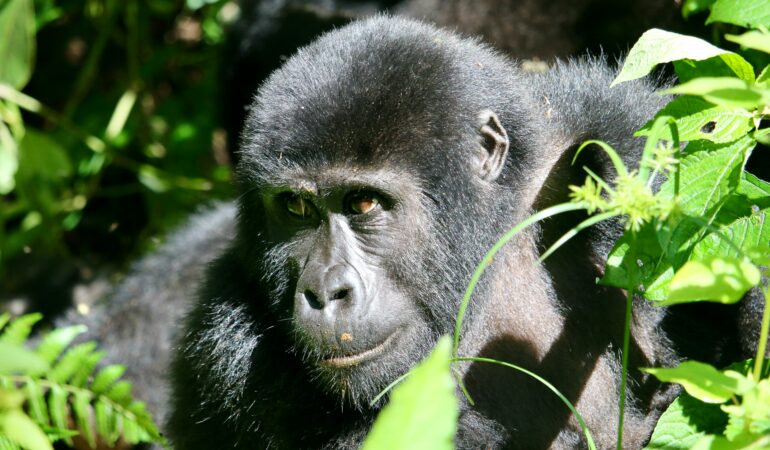
During gorilla trekking safaris, many visitors describe eye contact with a mountain gorilla as profoundly moving because the emotional expressions seem remarkably familiar.
Communication Beyond Simple Sounds
Mountain gorillas communicate through an impressive combination of vocalizations, gestures, facial expressions, posture, and touch. Scientists have identified numerous vocal sounds used in different situations, ranging from contentment and reassurance to warnings and calls for group movement.
Gentle grunts often accompany feeding sessions, helping maintain contact while individuals spread through vegetation. Infants squeal during play, adults bark when alarmed, and silverbacks produce the famous chest beats that serve multiple communication purposes.
Contrary to popular belief, chest beating is not always aggressive. It often communicates confidence, establishes identity, reinforces social status, or prevents unnecessary physical confrontation.
Facial expressions further enrich gorilla communication. Raised brows, direct eye contact, relaxed mouths, and subtle body positioning all convey important information understood by other members of the family.
Learning Through Observation
Young gorillas spend years observing adults before reaching maturity. This extended childhood allows them to learn feeding techniques, social etiquette, climbing skills, nest construction, and conflict resolution through observation rather than trial and error alone.
Juveniles imitate adult behaviors during play, gradually refining their skills as they mature. Mothers rarely provide explicit instruction. Instead, infants learn by carefully watching experienced family members interact with their environment.
This observational learning represents another hallmark of advanced intelligence and contributes significantly to the long-term stability of gorilla families.
Problem-Solving in the Rainforest
Living in dense montane forests presents countless daily challenges requiring flexible thinking. Mountain gorillas continuously evaluate terrain, locate nutritious vegetation, avoid hazards, and adapt to changing environmental conditions.
When familiar feeding areas become less productive, gorilla groups adjust their movement patterns accordingly. They remember the locations of seasonal food sources and modify travel routes to maximize feeding efficiency.
Silverbacks must also assess potential threats from neighboring groups while balancing the nutritional needs of their families. These decisions demonstrate planning and adaptive reasoning rather than automatic behavioral responses.
Although mountain gorillas use fewer tools than chimpanzees, their environmental problem-solving abilities remain highly sophisticated and perfectly suited to their ecological niche.
Memory and Recognition
Excellent memory plays an essential role in gorilla survival. Individuals recognize members of their own family even after periods of separation and remember established social relationships within the group.
Long-term memory also enables gorillas to navigate complex forest landscapes efficiently. They remember fruiting trees, water sources, resting sites, and safe travel corridors developed through years of experience.
Research suggests that gorillas also recognize familiar human researchers and guides who have spent extended periods observing habituated families. This recognition highlights their ability to distinguish between individual humans based on repeated interactions.
Visitors often notice how calmly habituated gorillas respond to professional ranger guides during gorilla trekking in Uganda, reflecting years of carefully managed habituation built upon mutual familiarity.
Play as a Sign of Intelligence
Play serves a critical role in cognitive development among mountain gorillas. Young gorillas wrestle, chase one another, climb trees, roll downhill, and invent imaginative games that strengthen physical coordination while developing social skills.
Through play, juveniles learn boundaries, cooperation, communication, and emotional regulation. Adults occasionally participate as well, reinforcing family bonds while encouraging healthy development.
Scientists recognize play as an important indicator of advanced intelligence because it reflects learning beyond immediate survival needs.
Watching playful juvenile gorillas often becomes one of the most memorable moments during a gorilla trekking safari, offering visitors a glimpse into the curiosity and creativity that characterize these remarkable primates.
Do Mountain Gorillas Use Tools?
Compared to chimpanzees, mountain gorillas use tools less frequently because their environment generally provides abundant food without requiring complex extraction techniques. However, observations of western gorillas have documented individuals using sticks to test water depth, branches for balance while crossing swamps, and natural objects to assist movement.
The relatively limited use of tools should not be interpreted as lower intelligence. Instead, it reflects different ecological demands. Mountain gorillas possess the cognitive capacity for tool use but simply encounter fewer situations where tools offer significant advantages.
Intelligence should therefore be measured by adaptability rather than the frequency of tool use alone.
Intelligence Supports Conservation Success
Understanding gorilla intelligence has transformed conservation strategies across East Africa. Recognizing mountain gorillas as emotionally complex, socially sophisticated beings has strengthened global commitment to protecting them.
Responsible tourism now prioritizes minimizing stress, maintaining safe viewing distances, limiting visitor numbers, and preventing disease transmission. These guidelines acknowledge that gorillas respond psychologically as well as physically to human presence.
Every permit purchased through Monumental Gorilla Tours contributes directly to conservation funding, park management, veterinary programs, ranger patrols, and community development initiatives that protect gorilla habitats for future generations.
Experience Gorilla Intelligence Firsthand
Reading about gorilla cognition offers valuable insight, but nothing compares to observing these behaviors in person. During a guided gorilla trekking safari, visitors often witness silverbacks calmly leading their families, mothers nurturing infants, juveniles engaging in playful exploration, and adults communicating through subtle gestures that reveal extraordinary social awareness.
The experience frequently changes perceptions of wildlife forever. Many travelers leave Uganda with a renewed appreciation for the intelligence shared across the great ape family and a stronger commitment to global conservation efforts.
At Monumental Gorilla Tours, we specialize in creating personalized gorilla trekking experiences that combine expert guiding, carefully selected accommodations, reliable permit arrangements, and immersive wildlife encounters across Uganda.
If you are planning your first gorilla adventure or returning to explore Uganda’s remarkable biodiversity once again, our experienced team can help design an itinerary that matches your interests, schedule, and travel style.
Plan Your Gorilla Trek with Monumental Gorilla Tours
Few wildlife experiences compare to spending an hour with one of the world’s most intelligent animals in its natural habitat. Monumental Gorilla Tours is committed to delivering professionally guided gorilla trekking safaris that combine exceptional service, responsible tourism, and unforgettable encounters with mountain gorillas. Whether you are traveling alone, as a couple, with family, or as part of a group, we will help you create a safari that showcases Uganda’s extraordinary wildlife while supporting long-term conservation.