August 11, 2026
Kidepo Valley vs Murchison Falls: Which Park Is Better?
Uganda’s two great northern safari destinations couldn’t feel more different from one another, despite both ranking among the country’s finest wildlife parks. The question of Kidepo Valley vs Murchison Falls comes up often among travelers piecing together a Uganda itinerary, since both parks sit in the country’s less-visited north, both offer exceptional game viewing, and both require a genuine commitment of time and planning to reach. Yet the experience each delivers, in scenery, wildlife, accessibility, and overall atmosphere, diverges sharply enough that the right choice depends heavily on what kind of safari you’re after. This guide compares both parks in detail to help you decide.
Getting a Sense of Each Park
Murchison Falls National Park is Uganda’s largest and oldest protected area, spanning nearly 3,900 square kilometers around the point where the Nile River forces itself through a narrow gorge before plunging into the falls that give the park its name. It sits roughly 305 kilometers northwest of Kampala, reachable by a five-to-six-hour drive or a roughly one-hour scheduled flight, and has long been one of Uganda’s most visited parks thanks to its relative accessibility and its combination of dramatic scenery, strong game viewing, and one of Africa’s most scenic river cruises.
Kidepo Valley National Park sits far further north, near the border with South Sudan and Kenya, in one of Uganda’s most remote and rugged corners. Covering around 1,442 square kilometers of semi-arid savanna framed by the Morungole and Napore mountain ranges, Kidepo has a reputation as one of Africa’s most spectacular, least-visited parks, often described by seasoned safari travelers as feeling more like a private wilderness than a conventional national park given how few other vehicles are typically encountered on a given day.
Comparing the Landscape and Scenery
Scenery is where these two parks tell genuinely different stories. Murchison Falls combines open savanna and woodland on its northern bank with lush riverine forest along the Nile itself, all built around the singular drama of the falls, where the entire river compresses through a gorge just seven meters wide. The landscape feels varied and dynamic, shifting from grassland to forest to the thundering water feature that gives the park its identity.
Kidepo’s scenery leans dramatically toward the rugged and expansive. Wide, golden-brown valleys stretch toward jagged, often cloud-wrapped mountain ranges, with the seasonal Narus and Kidepo rivers cutting through the landscape and drawing wildlife toward their banks during the dry months. The overall impression is closer to the classic imagery of East African wilderness, open horizons framed by distant peaks, than Murchison’s more forested, river-dominated terrain. Many travelers who have visited both parks describe Kidepo’s scenery as the more visually striking of the two, though Murchison’s Nile gorge and waterfall remain a singular, unmatched feature that Kidepo simply doesn’t have an equivalent for.
Comparing the Wildlife
Both parks deliver strong Big Five potential, though the specifics differ in ways worth understanding before choosing between them.
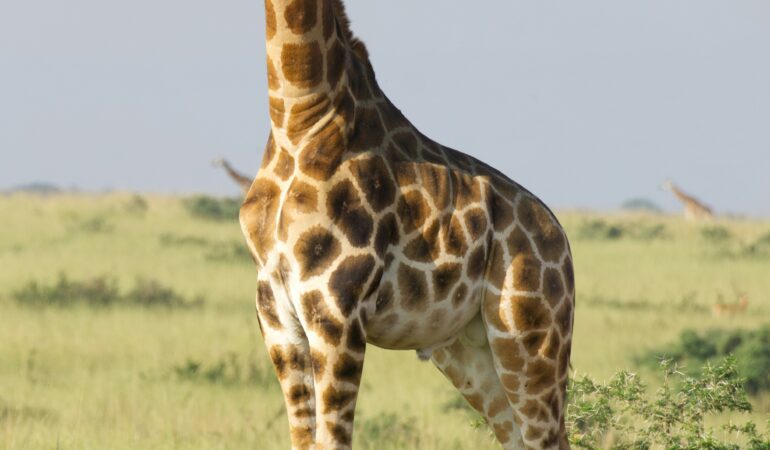
Murchison Falls offers reliable sightings of elephant, buffalo, lion, and Uganda’s largest population of Rothschild’s giraffe, alongside Jackson’s hartebeest, Uganda kob, and, along the river itself, enormous concentrations of hippo and Nile crocodile visible from the boat cruise. Leopard sightings occur but remain less predictable given the species’ elusive nature.
Kidepo’s wildlife list includes several species found nowhere else in Uganda, a significant draw for repeat visitors and dedicated wildlife enthusiasts. Cheetah are present in Kidepo and essentially absent from the rest of the country’s parks, making this the only realistic place in Uganda to see them. The park also hosts bat-eared fox, aardwolf, and striped hyena, species that don’t appear in Murchison’s more forested, riverine ecosystem. Kidepo’s lion prides are known for a similar tree-climbing behavior to that seen in Queen Elizabeth National Park’s Ishasha sector, an unusual and photogenic trait. Large buffalo herds, elephant, and substantial numbers of Uganda kob and Jackson’s hartebeest round out a wildlife profile that, while smaller in overall density than Murchison’s, offers a genuinely different and in some ways rarer set of species.
Murchison generally wins on sheer volume and reliability, given its larger visitor infrastructure and more established game-viewing routes, while Kidepo wins on rarity and the sense of encountering wildlife in a landscape that feels almost untouched by tourism.
Accessibility: The Deciding Factor for Many Travelers
This is where the comparison becomes most practical, and often the deciding factor for travelers with limited time. Murchison Falls is comparatively easy to reach, with a manageable road journey from Kampala or a short scheduled flight, making it feasible to combine with other parts of a Uganda itinerary without losing multiple days to transit.
Kidepo’s remoteness is both its greatest asset and its most significant logistical challenge. The drive from Kampala takes a full day, roughly ten to twelve hours, along roads that, while improved in recent years, remain considerably rougher than the route to Murchison. Because of this, virtually all visitors to Kidepo choose to fly, with scheduled light aircraft connecting Entebbe to the park’s airstrip in around two hours, still a meaningfully longer and costlier journey than the flight to Murchison.
This accessibility gap means Kidepo generally suits travelers with more time and a higher travel budget, or those specifically seeking out one of Africa’s most remote parks as a dedicated highlight of their trip, while Murchison works well for travelers wanting strong wildlife viewing without sacrificing multiple days purely to reach the park.
Combining Each Park with the Rest of Uganda
Murchison Falls’ relative accessibility makes it a natural anchor for a broader itinerary, easily combined with a stop at Ziwa Rhino Sanctuary en route, or paired with Uganda’s western circuit covering Queen Elizabeth National Park, Kibale Forest, and Bwindi Impenetrable Forest for a comprehensive multi-region safari. Its position and infrastructure make it one of the easiest parks in Uganda to fold into a wider trip without excessive additional travel time.
Kidepo, given its distance from the rest of the country’s major parks, is typically visited as either a dedicated standalone trip or as an extension tacked onto a longer overall Uganda itinerary, most often flown in and out directly rather than combined by road with other destinations. Travelers with ten days or more, and a genuine interest in Uganda’s more remote corners, are best positioned to include Kidepo without feeling rushed elsewhere.
For travelers weighing how Murchison fits into a broader gorilla-focused itinerary, our ultimate guide to Murchison Falls National Park covers the park’s full range of activities, from the Nile boat cruise to game drives and rhino tracking, in far more depth.
Accommodation Comparison
Murchison Falls benefits from a well-developed lodge scene, with options spanning comfortable mid-range properties to genuine riverside luxury, most concentrated around the Paraa area near the falls and boat cruise jetty. This range of choice makes it easy to find accommodation matching almost any budget.
Kidepo’s accommodation options are far more limited, reflecting its lower visitor numbers, with just a handful of lodges and tented camps operating within or near the park. Apoka Safari Lodge, built into a rocky outcrop overlooking the Narus Valley, stands out as the park’s premier property, offering genuinely luxurious stone-and-thatch accommodation with sweeping views that rank among the finest in Uganda. Beyond this and a small number of tented camps, choice is considerably narrower than what Murchison offers, something worth factoring in for travelers with specific accommodation preferences or budget constraints.
Cost Considerations
Kidepo’s remoteness translates directly into a higher overall trip cost. Flights are pricier than the Murchison route, accommodation options skew toward the higher end given the limited number of properties, and the overall logistics of reaching such a remote corner of the country add expense that simply doesn’t apply to a Murchison Falls itinerary. Travelers on a tighter budget, or those wanting strong wildlife viewing without a significant cost premium, will generally find Murchison the more economical choice.
Best Time to Visit Each Park
Both parks follow Uganda’s broader dry and wet season pattern, with the dry months, December through February and June through September, offering the best game viewing conditions and easiest road access at both destinations. Murchison’s roads become notably muddier during the wetter months, though remain passable, while Kidepo’s already-long road journey becomes considerably more arduous during heavy rains, reinforcing the case for flying rather than driving during the wetter parts of the year regardless of which park you choose.
So Which Park Should You Choose?
For travelers with limited time, a tighter budget, or those looking to combine northern Uganda wildlife viewing with other parts of the country without excessive additional travel, Murchison Falls is the stronger, more practical choice. Its combination of the dramatic falls themselves, strong Big Five viewing, the Nile boat cruise, and comparatively easy access makes it one of Uganda’s most complete and efficient safari destinations.
Kidepo Valley suits travelers with more time, a higher budget, and a specific desire to experience one of Africa’s truly remote, uncrowded wilderness areas, particularly those drawn to species like cheetah and bat-eared fox that don’t appear elsewhere in Uganda. For repeat visitors to Uganda who have already experienced the country’s more accessible parks, Kidepo often becomes the natural next destination precisely because it offers something genuinely different from anywhere else in the country.
For travelers who can manage the time and budget, combining both parks into a single extended northern Uganda circuit delivers an exceptional, wide-ranging safari, Murchison’s dramatic falls and river wildlife alongside Kidepo’s remote mountain scenery and rare predator species, all within one well-planned trip.
Planning Your Northern Uganda Safari with Monumental Gorilla Tours
Choosing between Kidepo Valley and Murchison Falls ultimately comes down to how much time and budget you have, and what kind of safari experience you’re after, efficient and accessible, or remote and exclusive. Our team at Monumental Gorilla Tours plans itineraries across both parks and can advise honestly on which fits your specific trip, or how to combine them into a single, well-sequenced northern Uganda circuit.
If Murchison’s combination of falls, wildlife, and river cruise appeals to you, our ultimate guide to Murchison Falls National Park is a strong next read. When you’re ready to move forward, reach out to our safari specialists for a tailored itinerary built around your available time, budget, and the parks that matter most to you.
Whichever park you choose, or if you decide to experience both, northern Uganda offers a side of the country’s wildlife story that feels distinctly different from the more familiar gorilla trekking circuit further south, wild, expansive, and, particularly in Kidepo’s case, still genuinely off the beaten path.