August 11, 2026
Chimpanzee Trekking in Kibale Forest: Full Visitor Guide
Kibale Forest National Park holds a title few other places on earth can claim: the primate capital of the world. With thirteen primate species crowded into 795 square kilometers of moist, tropical rainforest, and more than 1,500 chimpanzees calling the park home, chimpanzee trekking in Kibale Forest has become one of Uganda’s defining wildlife experiences, often ranked alongside gorilla trekking as a highlight of any East African safari. This guide covers everything a first-time visitor needs to know, from permits and habituation experiences to the forest’s wider wildlife, practical logistics, and where to stay.
Why Kibale Forest Stands Apart
Unlike Uganda’s gorilla parks, which sit in rugged, high-altitude terrain, Kibale occupies a moist, mid-elevation rainforest averaging around 1,500 meters above sea level, giving it a noticeably warmer, more humid character than Bwindi or Mgahinga. This climate supports an extraordinary density of primates, alongside more than 375 recorded bird species, over 70 mammal species, and a rich understory of fig trees, mahogany, and flowering shrubs that draws wildlife in tight concentration.
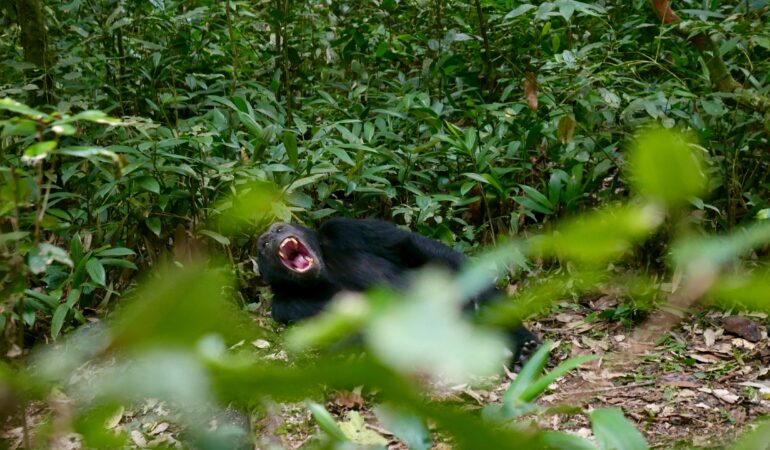
The park’s chimpanzee population is its centerpiece, and unlike gorilla trekking, where visitors spend a strict one hour with a habituated family, standard chimpanzee trekking in Kibale allows a full hour once the group is located, with tracking itself typically taking anywhere from thirty minutes to a few hours depending on how far the chimps have ranged that morning. Because chimpanzees are considerably more mobile and vocal than gorillas, often moving quickly through the canopy and calling loudly to coordinate as a group, the experience tends to feel more dynamic and unpredictable than a typical gorilla trek, part of what makes it such a compelling addition to any Uganda itinerary.
Kanyanchu: The Primary Trekking Hub
Nearly all standard chimpanzee treks in Kibale depart from Kanyanchu Visitor Center, the park’s main tourism hub, located centrally within the forest and easily reached from the nearby town of Fort Portal. Treks here begin with an early morning briefing, typically starting around 8:00 a.m., where certified park guides brief small groups of no more than six visitors per habituated chimpanzee community before heading into the forest.
Kanyanchu treks generally last between two and four hours in total, including tracking time, and follow a well-maintained network of forest trails that also pass through prime territory for red colobus monkeys, black-and-white colobus, and grey-cheeked mangabeys, meaning even before reaching the chimpanzees, visitors are usually treated to sightings of several other primate species along the way.
Permits for standard Kanyanchu trekking currently run a fixed daily allocation, issued by the Uganda Wildlife Authority, and should be booked several weeks to months in advance during peak travel periods, June through September and December through February, when demand from both international visitors and school holiday travelers rises sharply.
The Chimpanzee Habituation Experience
For travelers wanting a deeper, less time-constrained encounter, Kibale offers the Chimpanzee Habituation Experience, a full-day program that allows visitors to accompany researchers and trackers as they work with a community still in the process of becoming accustomed to human presence. Unlike the standard one-hour visit, this experience runs from early morning, often before 6:00 a.m., through early afternoon, giving participants four to six hours in close proximity to the chimpanzees as they feed, rest, groom, and move through their territory.
This program appeals strongly to photographers, researchers, and dedicated wildlife enthusiasts, since the extended time allows for a far more intimate understanding of chimpanzee behavior and social dynamics than the shorter standard trek permits. Because only a limited number of permits are issued daily for this experience, advance booking is essential, particularly for travelers with fixed dates who don’t want to risk missing out.
Beyond Chimpanzees: Kibale’s Wider Wildlife
While chimpanzees rightfully draw the most attention, Kibale’s biodiversity extends well beyond its most famous residents. The park hosts eleven other primate species alongside chimpanzees, including the L’Hoest’s monkey, blue monkey, red-tailed monkey, and the striking red colobus, one of the largest remaining populations of this increasingly rare species anywhere in East Africa.
Birdwatchers find Kibale equally rewarding, with species such as the green-breasted pitta, African pitta, and blue-headed bee-eater drawing dedicated birding groups from around the world, particularly during the drier months when visibility through the canopy improves. The forest floor and swampy sections also support forest elephants, though sightings are considerably less frequent than the primate encounters that define most visits.
Just south of the main forest, the Bigodi Wetland Sanctuary offers an excellent half-day add-on activity, a community-run guided walk through papyrus swamp and forest edge habitat known for excellent birding and reliable sightings of black-and-white colobus troops, all while directly supporting the local community that manages the sanctuary.
Combining Kibale with Uganda’s Wider Safari Circuit
Kibale’s location in western Uganda places it naturally along the route between Queen Elizabeth National Park and Uganda’s gorilla trekking destinations, making it an easy and popular addition to a broader itinerary rather than a standalone destination. Many travelers combine a day or two of chimpanzee trekking in Kibale with a stop in Queen Elizabeth National Park for game drives and a boat cruise along the Kazinga Channel, before continuing south toward Bwindi Impenetrable Forest for gorilla trekking.
This pairing works particularly well logistically, since the drive from Kibale to Queen Elizabeth National Park’s northern sector takes roughly one to two hours, and the continuation south to Bwindi adds only a further four to five hours, meaning a well-planned circuit can cover chimpanzees, big game, and gorillas within a single, efficiently structured trip. For travelers weighing how to sequence a broader gorilla-focused itinerary, our guide on luxury lodges in Bwindi Impenetrable Forest is a useful companion piece once Kibale and Queen Elizabeth are locked into the plan.
Where to Stay Near Kibale Forest
Accommodation around Kibale ranges from comfortable mid-range lodges to a handful of genuinely upscale properties, most concentrated near the park’s eastern boundary close to Kanyanchu and Fort Portal town.
Primate Lodge Kibale sits directly inside the forest itself, one of the few properties in Uganda offering that level of proximity to the trekking trails, with both luxury cottages and more affordable forest bandas available across a range of budgets. Waking up to chimpanzee calls echoing through the canopy is a genuine feature of staying here rather than a marketing exaggeration.
Ndali Lodge, perched on the rim of a volcanic crater lake roughly a twenty-minute drive from the park, offers a different but equally memorable setting, with cottages overlooking the still, clear waters of Lake Nyinambuga and panoramic views across the Rwenzori foothills on clear days. The lodge’s setting makes it a popular choice for travelers wanting a scenic base slightly removed from the forest itself.
Kyaninga Lodge, built on the edge of another dramatic crater lake near Fort Portal, has become one of western Uganda’s most celebrated luxury properties, its striking timber-and-thatch main lodge and private cottages offering some of the finest views and most attentive service in the region, alongside easy access to both Kibale and the wider Fort Portal area.
Practical Trekking Tips
A few preparations make chimpanzee trekking in Kibale considerably more comfortable. Sturdy, broken-in hiking boots with good grip are essential, since forest trails can be muddy and uneven regardless of season, and long trousers and sleeves help guard against biting ants and thorny undergrowth common in tropical forest environments.
Given Kibale’s warm, humid climate, lighter clothing layers work better here than the heavier gear often recommended for higher-altitude Bwindi or Mgahinga treks, though a light rain jacket remains worthwhile year-round given the unpredictability of tropical rainfall. Insect repellent and a reasonable level of general fitness are both recommended, since even standard treks can involve several kilometers of walking across uneven forest terrain before locating the chimpanzees.
Photography enthusiasts should note that Kibale’s dense canopy creates challenging low-light conditions, so a camera capable of higher ISO performance, or a fast lens, makes a meaningful difference when chimpanzees are spotted moving through shaded understory rather than open clearings.
Best Time to Visit Kibale Forest
Kibale can be visited year-round, since chimpanzee trekking continues regardless of season, but conditions do shift noticeably between wet and dry months. The dry seasons, roughly June through September and December through February, offer firmer trails and generally easier walking conditions, along with the best birding visibility.
The wetter months, March through May and October through November, bring heavier rainfall and muddier trails, but also tend to see fewer visitors and occasionally better opportunities to observe chimpanzee feeding behavior, since fruiting trees are often more abundant during these periods, drawing chimpanzee communities into more predictable, closer feeding patterns.
Planning Your Kibale Trip with Monumental Gorilla Tours
Chimpanzee trekking in Kibale Forest offers one of Uganda’s most rewarding wildlife encounters, whether experienced as a standalone day trip or, as most of our guests choose, woven into a broader itinerary spanning Queen Elizabeth National Park and Uganda’s premier gorilla trekking destinations. The park’s combination of accessible trekking, exceptional primate density, and comfortable nearby lodges makes it one of the easiest additions to strengthen any western Uganda safari.
Our team at Monumental Gorilla Tours arranges chimpanzee trekking permits, the Habituation Experience, and full multi-destination itineraries connecting Kibale with the rest of Uganda’s wildlife circuit. If you’re already planning a gorilla trekking trip and want to add Kibale to the route, take a look at our guide to Bwindi’s luxury lodges for a sense of how the two destinations can fit together. When you’re ready to build your itinerary, reach out to our safari specialists for a tailored plan built around your travel dates, fitness level, and the primate and wildlife experiences that matter most to you.
However you choose to experience it, a morning spent following a chimpanzee community through Kibale’s dense, humming forest, watching them feed, call, and move through the canopy just meters away, ranks among the most vivid wildlife encounters Uganda has to offer.